Most people start looking at energy efficient windows because of a utility bill. That's a fair reason, but it undersells what changes — the comfort difference is usually what homeowners notice first and talk about longest.
Comfort is the benefit you'll actually feel
Why the glass decides how a room feels
This guide covers what energy efficient windows genuinely do, what the performance numbers on the label mean, and how to judge whether an upgrade makes sense for your house. No hype, and no promised savings figure, because anyone quoting one without seeing your home is making it up. A window is the weakest part of any exterior wall. Even a good one insulates far less than the framed and insulated wall around it, which is why so much of how a room feels comes down to the glass.
Fewer drafts
What most people call a draft near a window is often not air leaking in at all — it's air cooling against cold glass, getting denser, and sliding down onto the floor. Better-insulating glass raises the interior surface temperature, and that convection current weakens.
Usable space near windows
Rooms with a lot of glass tend to have a dead zone in front of it during cold weather. Warmer interior glass surfaces pull that zone back and make a window seat or a desk by the window comfortable again.
Steadier temperatures
Less heat moving through the envelope means longer, gentler cycles from your heating and cooling equipment, and smaller swings between them.
Less overheating in summer
Coated glass turns away a good share of solar heat, which matters most on south- and west-facing rooms that bake through humid afternoons.
What the numbers on a window label mean
Four ratings worth learning
Window performance is measured under standard test conditions, so the numbers on the label let you compare products honestly. Learning four of them is enough to shop well. U-factor is the rate heat moves through the whole assembly, glass and frame together, and lower is better; through a long Midwest heating season, this is the number that matters most. Solar heat gain coefficient, or SHGC, is the fraction of solar heat that gets through the glass, where lower means less summer heat gain and higher means more free winter warmth — in a climate with both real winters and humid summers, the right answer sits in the middle and can differ by which direction a window faces. Visible transmittance, or VT, is how much daylight comes through, and because a very low SHGC sometimes costs you daylight, it's worth checking both. Air leakage is how much air passes through the assembly itself, where lower is tighter, and it's tied as much to build quality as to glass. Ratings describe measured performance, and they vary by product line and even by glass package within a line. Ask to see the actual label for the specific unit you're being quoted, not a brochure for the product family.
The technology behind the numbers
Low-E coatings are microscopically thin metallic layers on the glass that reflect infrared energy while letting visible light through; in winter they keep radiant heat inside, in summer they turn solar heat away, and different coatings tune that balance differently. Multi-pane construction uses two or three panes to create sealed insulating spaces, and it's the gap that does the insulating, not the glass. Gas fills of argon, and sometimes krypton, conduct heat more slowly than air, so the same gap performs better. Warm-edge spacers are the material separating the panes at the perimeter; older metal spacers conducted heat straight around the insulating space, which is why condensation and frost tend to start at the bottom edge of an older unit. Frame material matters as well, because vinyl, fiberglass, composite, and wood-clad frames insulate differently and move differently through freeze-thaw cycling. The frame is part of the U-factor, not an afterthought.
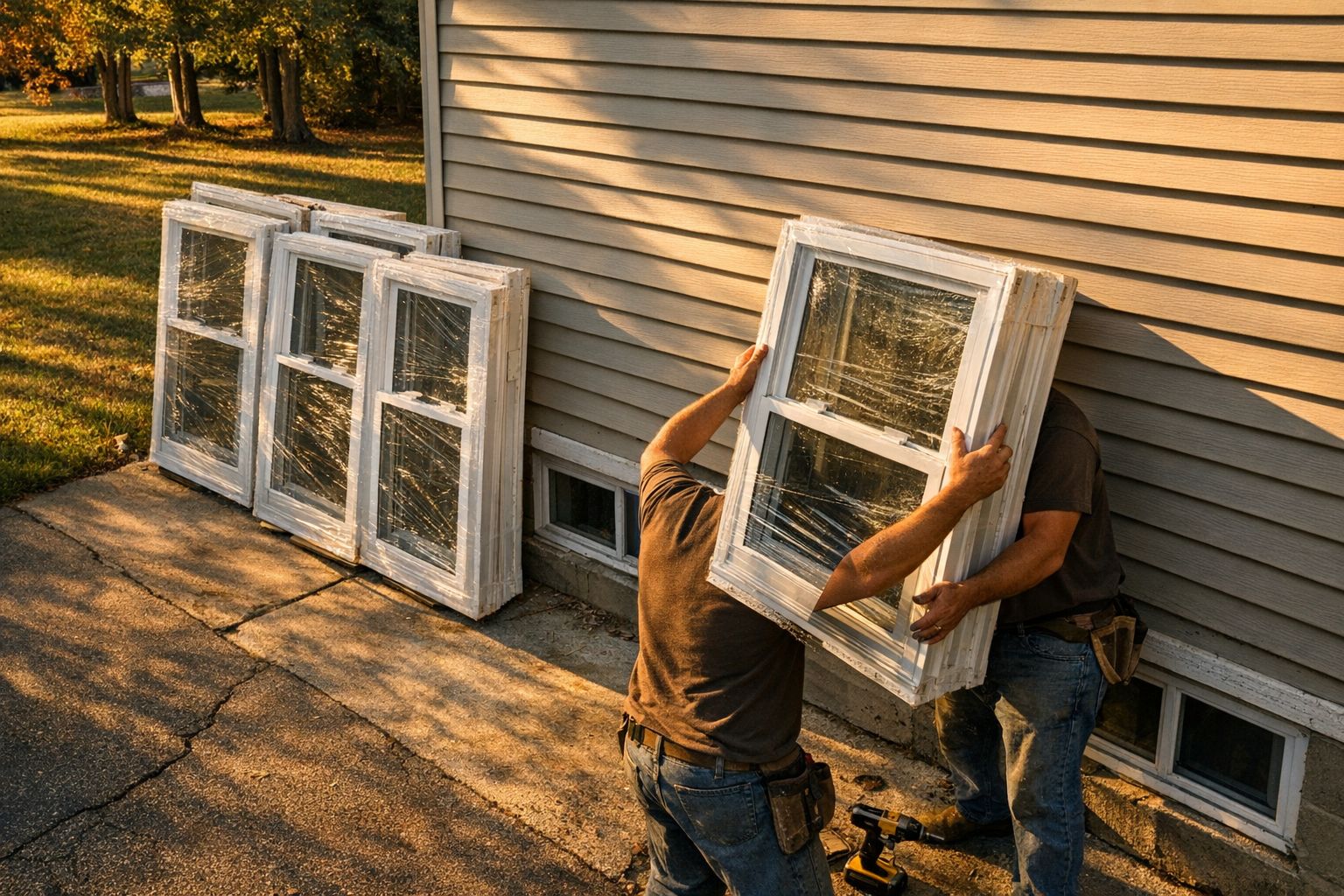
Set and shimmed in the opening — Gary, IN
Condensation, moisture, and indoor air
Warmer glass, less water on the sill
Interior condensation isn't usually the window's fault — it's humid indoor air meeting a cold surface. But the window decides how cold that surface gets, and that's where the improvement comes from. Raising interior glass temperature with better glass, a gas fill, and a warm-edge spacer means the surface stays above the dew point more of the time. Less condensation means less water sitting on sills and less of the chronic dampness that leads to peeling paint, stained casing, and mildew at the bottom of the sash. Newer weatherstripping and proper air sealing at the opening also cut down on the dust and outdoor particulates that ride in through gaps — which matters in an area with industrial neighbors and heavy truck and rail traffic nearby.
Quieter rooms
Sound and heat move differently, but multi-pane assemblies help with both. Two or three panes at different thicknesses, separated by sealed gaps and set in a tight frame, break up sound transmission far better than a single pane with an aluminum storm over it. Traffic, trains, and neighborhood noise all soften. It won't make a room silent, and if quiet is your priority, say so while you're specifying — laminated glass and mismatched pane thicknesses do more for sound than anything else on the option list.
Durability, upkeep, and resale
Service life, coverage, and what resale really means
Modern frames and coatings are built to sit in weather. Vinyl and fiberglass don't need painting, hardware is more robust than it used to be, and tilt-in sash makes cleaning possible without a ladder. As a general industry range, quality replacement windows are considered to have a service life of roughly two to three decades, with the insulated glass seal usually being the first thing to go. Manufacturers back their products with warranty coverage that varies by line — read the terms on the specific unit you're buying, and check whether coverage transfers if you sell. On resale, real estate professionals routinely list windows among the improvements buyers notice, for appearance and because buyers ask about efficiency. Treat that as a genuine but unquantifiable benefit, and ignore any specific return-on-investment figure quoted online.
Is an upgrade worth it for your house?
When windows are the right priority
Windows are worth prioritizing when the existing ones are single-pane, when insulated units have fogged because their seals failed, when sash bind or won't stay up, or when you can feel the cold radiating off the glass from a few feet away. If your windows are already reasonably tight double-pane units, air sealing the attic and rim joist and adding insulation usually buys more comfort for the money. A good estimator will tell you that instead of selling you glass you don't need. The variables that decide the answer for your home are your current windows' condition, your exposures, how the house is insulated, and how long you plan to stay. That's a walkthrough conversation, not a phone call.
Find out what your home needs
The honest next step
If you're weighing a whole house window replacement, the honest next step is having someone measure your openings and look at what's actually there. You'll get a written price, a straight answer about which upgrades matter for your exposures, and no obligation to move forward. Reach out or send the free in-home estimate form — it takes 60 seconds and we'll follow up to schedule.
Ready to Replace Your Windows?
Get a free in-home estimate on your own openings. No obligation, and you get a written scope before any work starts.
📞 Call (219) 200-4360