
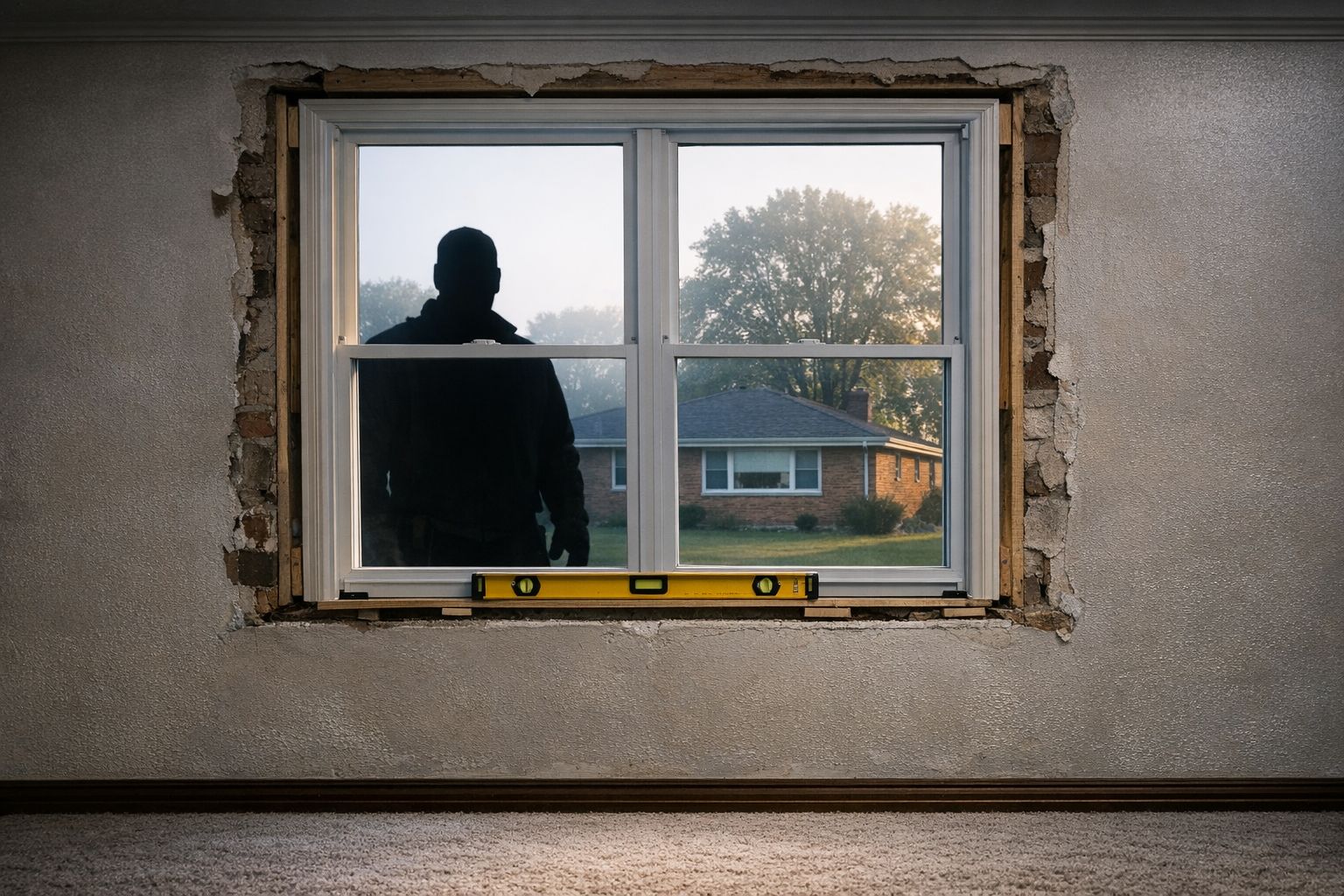
Double hung window replacement in Gary, IN
Double hung window replacement swaps a two-sash window — both of which slide vertically — for a new unit built to the exact dimensions of your opening. It's the most common style in Northwest Indiana homes because it fits the tall, relatively narrow openings that builders here used for a century, and modern versions tilt inward so both sides of the glass can be cleaned from inside. Most homes are measured, ordered and installed within a few weeks, with the installation itself taking one to a few days. If you live in a home around here, odds are good you're already looking at double hung windows, and replacing like with like means the proportions of your house stay right and the openings usually don't need to be altered. What changes is everything inside the frame.
What a modern double hung actually improves
Same shape, different machine
They're what went into the brick bungalows and two-flats, into the postwar ranches and split-levels, and into most of the subdivisions built since. An older double hung window is two panes of glass in a wood or aluminum frame, held up by a rope-and-weight system or a spring balance that has probably given out by now. A current one is a different machine wearing the same shape. Both sashes tilt in, so you clean the outside of a second-story window standing in your own bedroom; this is the feature homeowners notice most after the fact. Modern block-and-tackle or coil balances keep a sash where you put it instead of letting it drift down or requiring a book to prop it. There's a real seal at the meeting rail, where the joint between the two overlapping sashes is the classic draft point on an old double hung, closed here by interlocking rails and compression weatherstripping. Insulated glass with a low-E coating means two or three panes with a sealed, gas-filled space between them and a microscopically thin coating that reflects heat back where you want it. Vinyl, composite and fiberglass frames don't absorb moisture, swell shut in humidity, or need scraping and repainting on a cycle. And warm-edge spacers, the strip separating the panes at their perimeter, conduct far less heat than the aluminum spacers used in older units, which raises the temperature at the edge of the glass — the spot where condensation appears first.
Why double hung suits Northwest Indiana specifically
Architecture and weather
Two reasons, one architectural and one about weather. Architecturally, the housing stock here was built around vertical openings — tall and narrow on the older pre-war homes, wider and shorter on the postwar ranches, but almost always proportioned for a two-sash vertical window. Putting a slider or a casement into an opening designed for a double hung usually means either altering the framing or accepting a window that looks wrong on the elevation. On weather: our winters bring long stretches of cold with lake-effect wind, and our summers bring real humidity. A double hung lets you vent a room from the top sash, which pulls warm air out near the ceiling without pointing a draft at anyone, and it lets you leave a window cracked in weather where a casement swinging outward would catch wind and rain. Repeated freeze-thaw cycling is also hard on windows — it works at seals and at any joint that moves — which is why the quality of the balance hardware and the weatherstripping matters more here than a spec sheet suggests.
Matching the window to your house
Sightlines and frame width
The mechanical part of a double hung is standardized. The part that decides whether the finished job looks right isn't. Every replacement window has a frame, and that frame takes up some of the opening. A unit with a bulky frame in a modest opening loses visible glass and makes the window look smaller than the one you took out. On a house where several windows sit in a row on one elevation, the difference is obvious. Narrower-profile frames cost more and give back glass — sometimes worth it, sometimes not, depending on the elevation.
Grille patterns
The bars dividing the glass are cosmetic on a modern window, and the pattern is a real decision. A pre-war home often wants a divided upper sash over a clear lower one, or a symmetrical pattern in both. A mid-century ranch usually wants no grilles at all. A colonial-influenced elevation wants a consistent grid. Getting this wrong is the single easiest way to make a new window look cheap on an old house.
Insert or full-frame
An insert replacement sets a new unit inside your existing frame, keeping the exterior trim and interior casing intact — less disruption, faster, and it slightly reduces the glass area. A full-frame replacement takes everything back to the rough opening, which is what you need when the existing frame is rotted, when the opening has shifted out of square, or when you want to recover every bit of glass. Which one your house needs is a decision made at the opening with the trim in view, not from a catalog.
How the work goes
In-home assessment
We look at every opening from inside and out, check the condition of the frames and sills, talk through style and glass options, and leave you a written estimate. Free, no obligation.
Final measuring
Once you approve a scope, someone returns to measure each opening precisely. Double hung units are built to your dimensions, so this step is what keeps a custom order from arriving wrong.
Fabrication
Units are manufactured to those measurements.
Installation
Openings are worked one at a time and closed the same day. Interior floors and furnishings get covered, old units are hauled away, and the exterior joint gets sealed and finished.
Walkthrough
Every sash gets operated, tilted, locked and adjusted with you there.
What affects the cost
The factors that move it
There's no honest per-window figure without measurements, but these are the factors that move it: how many openings you're doing, how large they are, the frame material, whether you choose double or triple pane and which low-E coating, grille options, whether the job is insert or full-frame, access on upper floors, and the condition of the existing framing. Rot found behind an old unit gets repaired before a new window goes in — we tell you before doing anything about it.
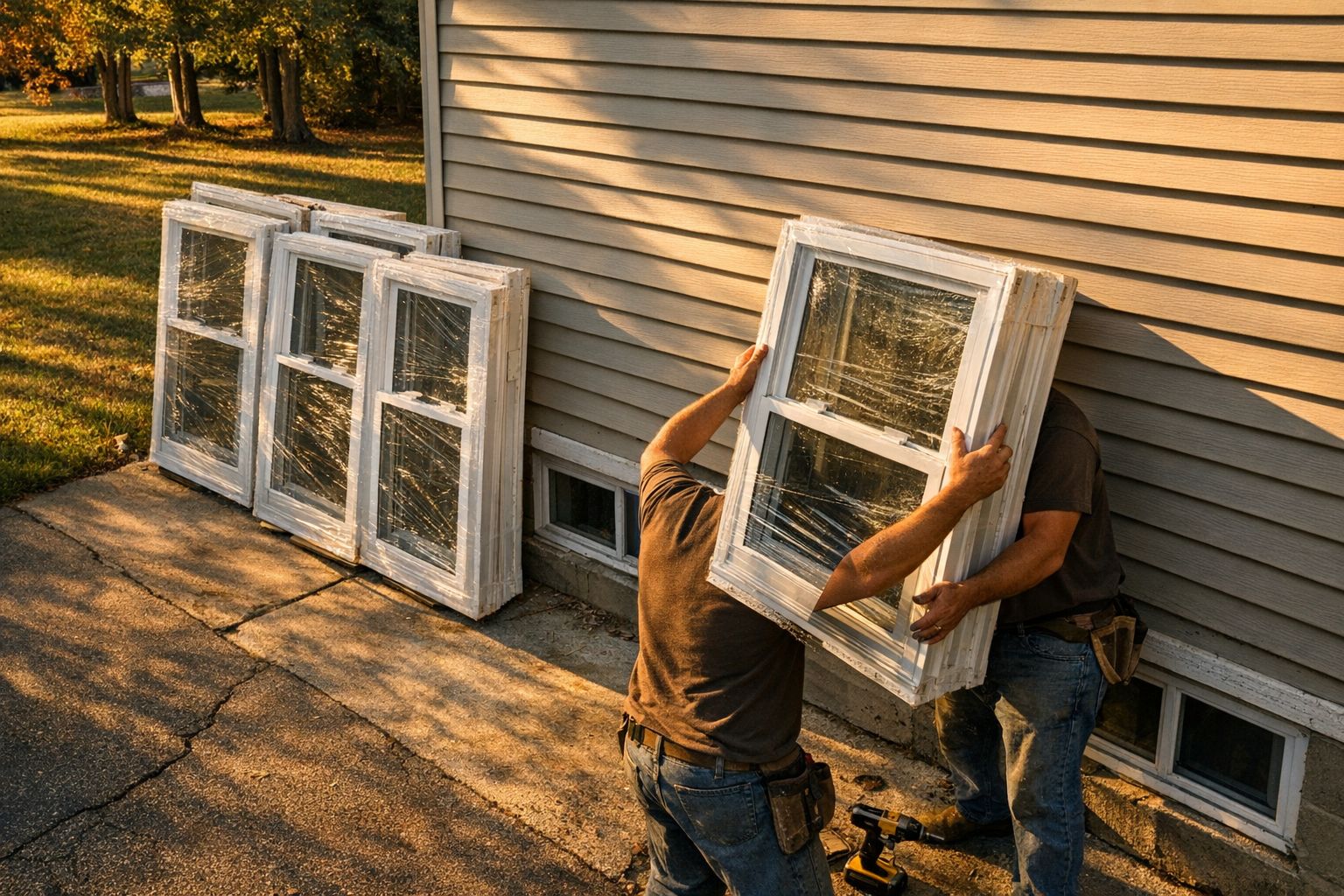
New double-hung units staged at the house before install — Gary, IN
Reach out to talk through your openings, or request a free in-home estimate — it takes about 60 seconds and carries no obligation. You'll get a written number, a clear scope, and a straight answer on whether your house wants inserts or full-frame units.
Free in-home estimates · No obligation · No pressure
📞 Call (219) 200-4360Get a Free Estimate
No obligation · No pressure
Takes 60 seconds · No obligation
Related Articles
Why Choose Us?
- Free In-Home Estimates
- Locally Operated
- No-Obligation Written Quote
- Opening-by-Opening Assessment
- Custom-Measured Units
- Full Cleanup & Haul-Away